
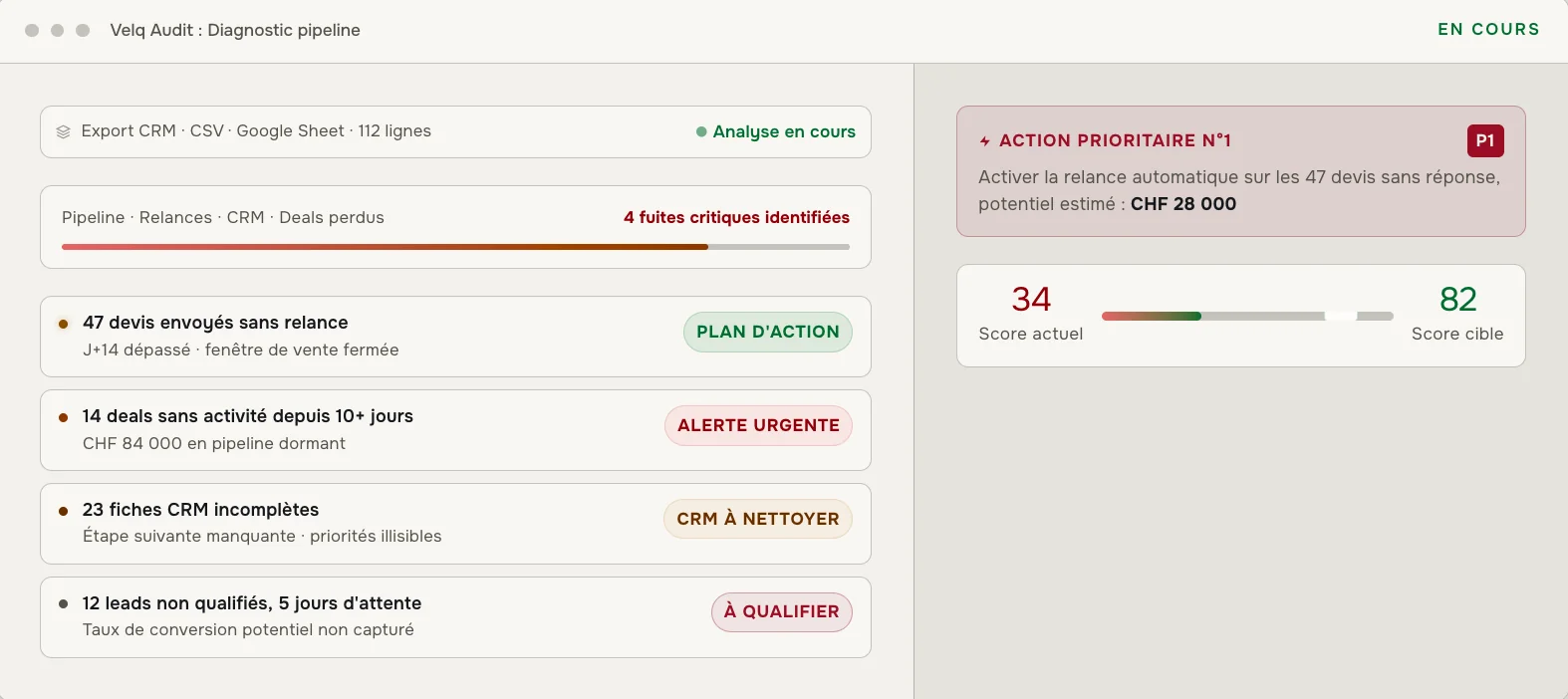
Eight years in sales left me with one observation: pipelines lose deals to forgotten follow-ups and poor organisation. SMEs want to fix that with AI without having the time or the in-house expertise to get started. Instead of theorising, I built the tool.
01 The problem
Follow-ups that slip, poorly qualified leads, reporting done by hand. As a HubSpot Key User and the person who ran the migration onto it, I saw from the inside what the tool does not do: its reporting tells you how many deals are open, not where the pipeline is leaking, and even less what to do next.
Building yet another CRM made no sense. I plugged into the one the teams already use and added only what was missing: the leak diagnosis, then the follow-up plan that comes out of it.
02 What I built
Velq is an AI service for SMEs and sales teams, deployed on Cloudflare Workers and Supabase. The core is a multi-agent system: an orchestrator breaks the work down and routes each piece to the agent whose job it is.
The guardrail sits upstream of the model. Velq treats a fact as verified only if it actually read the company's page, and then cites it with its source URL. Otherwise the prompt forbids it from asserting anything and requires every element to be presented as a hypothesis to confirm on the call.
Content pulled from a web page enters the prompt framed as data, with an explicit instruction that it is never a set of instructions to follow, and the extracted signals are sanitised before they get there. It is a defence against prompt injection, written because an agent that reads the web also reads whatever was left there for it.
03 What I take from it
Orchestrating agents comes down to deciding who handles what, where a human reviews and when an output has to be blocked. The same trade-offs as designing a product.
An agent that cannot prove what it claims has to say so. That is the rule Velq imposes on the model before it writes a word.
Diagnose
Plug into the existing CRM and read where the pipeline leaks, instead of building yet another one.
Orchestrate
An orchestrator breaks the work down and routes it to 17 specialised agents.
Prove
A fact is verified only if the source page was read; otherwise it is presented as a hypothesis.
Result
17specialised agents driven by a central orchestrator
- Company research before a call, lead qualification against an ICP, sequence strategy, meeting prep
- A fact counts as verified only if the source page was read, and it is cited with its URL
- Content pulled from the web enters the prompt as data, never as instructions